We are Covering Best and Beautiful Birds Facts, Info, Birds Photos & pictures with free desktop wallpapers.
Monday, February 22, 2016
10 Lesser bird of paradise Facts pics
Beautiful Lesser bird of paradise Facts or Short Info
Lesser Birds of Paradise are extremely attractive and show fascinating courting behavior.
Birds of Paradise belong to the family Paradisaeidae. There are about 45 species, of which Lesser Birds of Paradise is one. The Lesser Birds of Paradise (Paradisaea minor) are found in lowland rainforests of New Guinea and other adjacent islands.
The lesser bird-of-paradise is medium-sized, up to 32 cm-long, maroon-brown with a yellow crown and brownish-yellow upper back. The male has a dark emerald-green throat, a pair of long tail-wires and is adorned with ornamental flank plumes which are deep yellow at their base and fade outwards into white. The female is a maroon bird with a dark-brown head and whitish underparts. Further study is required,[2] but it seems likely that birds-of-paradise also possess toxins in their skins, derived from their insect prey.
It resembles the larger greater bird-of-paradise, but the male of that species has a dark chest, whereas the female is entirely brown (no whitish underparts).
Breeding: The males are polygamous, and perform courtship displays in leks. The female usually lays two pinkish eggs with dark markings in a nest in a tree high above ground. Its diet consists mainly of fruits and insects.
Beautiful Lesser bird of paradise pics / Pictures
Monday, May 21, 2012
12 Most Beautiful Birds Photos-Pictures
"The World Most Beautiful Birds 12 Photos & Pictures"
Lesser Bird of Paradise
African Crowned Crane bird
Quetzal guatamala bird
American kestrel bird
Australian lyre bird
Puffin Bird
Bird Gurney pitta
White Pelican bird
Red kite Bird
Parrot bird
Lorikeet bird
Cardinal bird red
Lesser Bird of Paradise
African Crowned Crane bird
Quetzal guatamala bird
American kestrel bird
Australian lyre bird
Puffin Bird
Bird Gurney pitta
White Pelican bird
Red kite Bird
Parrot bird
Lorikeet bird
Cardinal bird redMonday, March 12, 2012
Plains Wanderer Birds Photos, Plains Wanderer Facts & info
Plains Wanderer Birds Facts & info :
> Binomial name - Pedionomus torquatus
> measuring 15–19 cm
> They are poor flyers, preferring to run when startled
> Females lay four eggs, which the male then incubates
Scientific classification
> Kingdom - Animalia
> Phylum - Chordata
> Class - Aves
> Order - Charadriformes
> Family - Pedionomidae
> Bonaparte - 1856
> Genus - Pedionomus
> Gould - 1841
> Species - P. torquatus
The Plains-wanderer birds or Plains Wanderer, is a bird, the only representative of its family. It is endemic to Australia. The majority of the remaining population are found in the Riverina region of New South Wales. (more information Plains Wanderer Birds from wikipedia.com)
Plains Wanderer Birds Photos :


> Binomial name - Pedionomus torquatus
> measuring 15–19 cm
> They are poor flyers, preferring to run when startled
> Females lay four eggs, which the male then incubates
Scientific classification
> Kingdom - Animalia
> Phylum - Chordata
> Class - Aves
> Order - Charadriformes
> Family - Pedionomidae
> Bonaparte - 1856
> Genus - Pedionomus
> Gould - 1841
> Species - P. torquatus
The Plains-wanderer birds or Plains Wanderer, is a bird, the only representative of its family. It is endemic to Australia. The majority of the remaining population are found in the Riverina region of New South Wales. (more information Plains Wanderer Birds from wikipedia.com)
Plains Wanderer Birds Photos :


Ibisbill Birds Photos, Ibisbill Facts & info
Ibisbill Birds Facts and Info :
The Ibisbill bird is a bird related to the waders, but sufficiently distinctive to merit its own family Ibidorhynchidae. Ibisbill bird is grey with a white belly, red legs and long down-curved bill, and a black face and black breast band. It occurs on the shingle riverbanks of the high plateau of central Asia and the Himalayas.
> This Ibisbill bird is 38–41 cm (15–16 in) long and is quite unmistakable in appearance
> The Ibisbill bird typically weighs 270–320 g (9.5–11 oz) and female birds weigh slightly more than male birds (more information from wikipedia.com)
Ibisbill Birds Photos :


The Ibisbill bird is a bird related to the waders, but sufficiently distinctive to merit its own family Ibidorhynchidae. Ibisbill bird is grey with a white belly, red legs and long down-curved bill, and a black face and black breast band. It occurs on the shingle riverbanks of the high plateau of central Asia and the Himalayas.
> This Ibisbill bird is 38–41 cm (15–16 in) long and is quite unmistakable in appearance
> The Ibisbill bird typically weighs 270–320 g (9.5–11 oz) and female birds weigh slightly more than male birds (more information from wikipedia.com)
Ibisbill Birds Photos :


Tuesday, February 28, 2012
Shoebill Birds Facts, Shoebill Bird Photos
Shoebills Birds Facts :
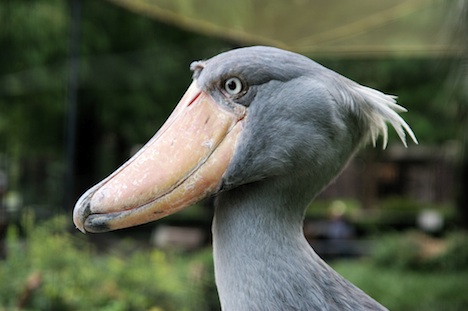
The Shoebill (Balaeniceps rex) also known as Whalehead or Shoe-billed Stork, is a very large stork-like bird. It derives its name from its massive shoe-shaped bill. The adult bird is 115 to 150 centimeters (45 to 59 in) tall, 100 to 140 centimeters (39 to 55 in) long, 230 to 260 centimeters (91 to 100 in) across the wingspan and weighs 4 to 7 kilograms (8.8 to 15 lb).[2][3] Their beaks have an average length of 30 centimeters (12 in). The adult is mainly grey while the juveniles are browner. It lives in tropical east Africa in large swamps from Sudan to Zambia.
Shoebill Ecology and behavior :
Shoebills feed in muddy waters, preying on fish, frogs, reptiles such as baby crocodiles, and small mammals. They nest on the ground and lay from 1 to 3 eggs, usually during the dry season. These eggs measure 80 to 90 millimeters (3.1 to 3.5 in) x 57 to 61 millimeters (2.2 to 2.4 in). Both parents incubate the eggs for about a month. The newborn chicks will be able to fly after about 100 days, while it will take them 3 years before they become fully sexually mature
Shoebill Birds Photos / Pictures :


The Shoebill (Balaeniceps rex) also known as Whalehead or Shoe-billed Stork, is a very large stork-like bird. It derives its name from its massive shoe-shaped bill. The adult bird is 115 to 150 centimeters (45 to 59 in) tall, 100 to 140 centimeters (39 to 55 in) long, 230 to 260 centimeters (91 to 100 in) across the wingspan and weighs 4 to 7 kilograms (8.8 to 15 lb).[2][3] Their beaks have an average length of 30 centimeters (12 in). The adult is mainly grey while the juveniles are browner. It lives in tropical east Africa in large swamps from Sudan to Zambia.
Shoebill Ecology and behavior :
Shoebills feed in muddy waters, preying on fish, frogs, reptiles such as baby crocodiles, and small mammals. They nest on the ground and lay from 1 to 3 eggs, usually during the dry season. These eggs measure 80 to 90 millimeters (3.1 to 3.5 in) x 57 to 61 millimeters (2.2 to 2.4 in). Both parents incubate the eggs for about a month. The newborn chicks will be able to fly after about 100 days, while it will take them 3 years before they become fully sexually mature
Shoebill Birds Photos / Pictures :


Wednesday, February 15, 2012
Kiwi Birds Pictures, Kiwi Birds Facts - Information
Kiwi Birds Facts - Information :
Kiwi birds are flightless birds endemic to New Zealand, in the genus Apteryx and family Apterygidae.
At around the size of a domestic chicken, kiwi birds are by far the smallest living ratites and lay the largest egg in relation to their body size of any species of bird in the world. There are five recognized species, all of which are endangered; all species have been adversely affected by historic deforestation but currently large areas of their forest habitat are well protected in reserves and national parks. At present, the greatest threat to their survival is predation by invasive mammalian predators.
The kiwi bird is a national symbol of New Zealand, and the association is so strong that the term Kiwi is used all over the world as the colloquial demonym for New Zealanders.
Kiwi Birds Interesting Facts :
Kiwi birds are extremely unique in the bird world. Though they are the size of chickens, they lay eggs the size of ostrich eggs, weighing around a pound each. Their enormous eggs are the largest in the bird world, in proportion to their bodies. These birds were named after their distinctive shrill cry "kee-wee kee-wee".
Kiwi Bird s Habitat :
The kiwi bird is native of New Zealand. It is the island country's national bird, and is rare anywhere but here and a few pacific island neighbors. Of course, it is available for viewing at certain zoos, including the San Diego Zoo. It has stayed in its native land due to the facts that it is an isolated island and that kiwis can't fly.
Cute Kiwi Birds Pictures :


Kiwi birds sizes :
The New Zealand Kiwi birds looks almost real in this beautiful replica of our iconic flightless Kiwi.
Made with artificial fur, this little Kiwi bird isn't endangered, but it's nice to have a model of him on the desk or mantelpiece.
New Zealand's flightless Kiwi birds are an endangered species, as introduced pests ( stoats, possums, weasels, dogs, cats) kill Kiwis or damage their habitat. Several organisations are working to save the Kiwi.
Kiwi birds comes in four sizes:
Large - approximately 11cm (4 1/4" ) tall
Medium - approximately 7.5cm (3") tall
Small - approximately 5cm (2") tall
Extra-Small - approx 4 cm (1 1/2") tall
Read more Kiwi Facts & information at Wikipedia.com
Kiwi birds are flightless birds endemic to New Zealand, in the genus Apteryx and family Apterygidae.
At around the size of a domestic chicken, kiwi birds are by far the smallest living ratites and lay the largest egg in relation to their body size of any species of bird in the world. There are five recognized species, all of which are endangered; all species have been adversely affected by historic deforestation but currently large areas of their forest habitat are well protected in reserves and national parks. At present, the greatest threat to their survival is predation by invasive mammalian predators.
The kiwi bird is a national symbol of New Zealand, and the association is so strong that the term Kiwi is used all over the world as the colloquial demonym for New Zealanders.
Kiwi Birds Interesting Facts :
Kiwi birds are extremely unique in the bird world. Though they are the size of chickens, they lay eggs the size of ostrich eggs, weighing around a pound each. Their enormous eggs are the largest in the bird world, in proportion to their bodies. These birds were named after their distinctive shrill cry "kee-wee kee-wee".
Kiwi Bird s Habitat :
The kiwi bird is native of New Zealand. It is the island country's national bird, and is rare anywhere but here and a few pacific island neighbors. Of course, it is available for viewing at certain zoos, including the San Diego Zoo. It has stayed in its native land due to the facts that it is an isolated island and that kiwis can't fly.
Cute Kiwi Birds Pictures :


Kiwi birds sizes :
The New Zealand Kiwi birds looks almost real in this beautiful replica of our iconic flightless Kiwi.
Made with artificial fur, this little Kiwi bird isn't endangered, but it's nice to have a model of him on the desk or mantelpiece.
New Zealand's flightless Kiwi birds are an endangered species, as introduced pests ( stoats, possums, weasels, dogs, cats) kill Kiwis or damage their habitat. Several organisations are working to save the Kiwi.
Kiwi birds comes in four sizes:
Large - approximately 11cm (4 1/4" ) tall
Medium - approximately 7.5cm (3") tall
Small - approximately 5cm (2") tall
Extra-Small - approx 4 cm (1 1/2") tall
Read more Kiwi Facts & information at Wikipedia.com
Cassowary Birds pictures, Cassowary Birds Facts
Cassowary Birds Facts :
The cassowaries are ratites, very large flightless birds in the genus Casuarius native to the tropical forests of New Guinea, nearby islands. There are three extant species recognized today. The most common of these, the Southern Cassowary, is the third tallest and second heaviest living bird, smaller only than the ostrich and emu.
Cassowary Birds Behaviour :
Cassowaries are solitary birds except during courtship, egg-laying, and sometimes around ample food supplies.[8] Male cassowaries defend a territory of about 7 square kilometres (1,700 acres) for itself and its mate, while females have overlapping territories of several males.
Cassowary Bird Attacks :
Cassowaries have a fierce-sum reputation and the razor like talons are used by the bird to slash their opponents flesh. With such powerful legs, this species can break bones with just one kick. During an attack, the Cassowary will charge at its victim, jump and kick out. Records indicate that the victims of Cassowary attacks have been both humans and dogs and in some instances have been fatal. As the Cassowary is particularly territorial, attacks have often occurred when they are defending territory, their young ones, or feel that their food source is under threat.
Cassowary Birds pictures :


Cassowary Bird Attacks Video :
Read more facts and information about Cassowary Birds from Wikipedia
The cassowaries are ratites, very large flightless birds in the genus Casuarius native to the tropical forests of New Guinea, nearby islands. There are three extant species recognized today. The most common of these, the Southern Cassowary, is the third tallest and second heaviest living bird, smaller only than the ostrich and emu.
Cassowary Birds Behaviour :
Cassowaries are solitary birds except during courtship, egg-laying, and sometimes around ample food supplies.[8] Male cassowaries defend a territory of about 7 square kilometres (1,700 acres) for itself and its mate, while females have overlapping territories of several males.
Cassowary Bird Attacks :
Cassowaries have a fierce-sum reputation and the razor like talons are used by the bird to slash their opponents flesh. With such powerful legs, this species can break bones with just one kick. During an attack, the Cassowary will charge at its victim, jump and kick out. Records indicate that the victims of Cassowary attacks have been both humans and dogs and in some instances have been fatal. As the Cassowary is particularly territorial, attacks have often occurred when they are defending territory, their young ones, or feel that their food source is under threat.
Cassowary Birds pictures :


Cassowary Bird Attacks Video :
Read more facts and information about Cassowary Birds from Wikipedia
Monday, January 9, 2012
Blue Bird of Paradise Photos-Facts
Blue Bird of Paradise Facts and Blue Bird of Paradise Photos :
> The Blue Bird of Paradise is regarded by ornithologists as the loveliest of all birds.
> The Blue Bird-of-paradise is a medium-sized Bird.
> The scientific name is Paradisaea rudolphi.
The species is approximately 30 cm long, black with a bluish-white bill, dark brown iris, grey legs, broken white eye-ring and bright blue wings. The male Bird is adorned with violet blue and cinnamon flank plumes and two long ribbon-like tail feathers. The female has a chestnut brown below.


> The Blue Bird of Paradise is regarded by ornithologists as the loveliest of all birds.
> The Blue Bird-of-paradise is a medium-sized Bird.
> The scientific name is Paradisaea rudolphi.
The species is approximately 30 cm long, black with a bluish-white bill, dark brown iris, grey legs, broken white eye-ring and bright blue wings. The male Bird is adorned with violet blue and cinnamon flank plumes and two long ribbon-like tail feathers. The female has a chestnut brown below.


Emperor Penguin Pictures, Emperor Penguin Facts
Emperor Penguin Facts and Emperor Penguin Pictures :
The Emperor Penguin (Aptenodytes forsteri) is the tallest and heaviest of all living penguin species and is endemic to Antarctica. The male and female are similar in plumage and size.
Above Emperor Penguin Picture© EnchantedLearning.com


A male Emperor penguin must withstand the Antarctic cold for more than two months to protect his eggs from extreme cold. During this entire time he doesn't eat a thing. Most male penguins will lose about 12 kg (26 lb) while they wait for their babies to hatch. The mean weight of males at the start of the breeding season is 38 kg (84 lb) and that of females is 29.5 kg (65 lb). After the breeding season this drops to 23 kg (51 lb) for both sexes.
Diet: Carnivore
Size (H): 100cm - 120cm (39in - 47in)
Weight: 22kg - 45kg (49lbs - 99lbs)
Life Span: 20 - 50 years
Lifestyle: Flock
Conservation Status: Least Concern
Colour: Black, White, Yellow, Grey
Skin Type: Feathers
Favourite Food: Squid
Habitat: Antarctic ice and sea
Average Litter Size: 1
Main Prey: Squid, Fish, Crabs
Predators: Leopard Seals, Sharks, Killer Whales
Distinctive Features: Large body size and bright yellow feathers on neck
Read more from Wikipedia
The Emperor Penguin (Aptenodytes forsteri) is the tallest and heaviest of all living penguin species and is endemic to Antarctica. The male and female are similar in plumage and size.


A male Emperor penguin must withstand the Antarctic cold for more than two months to protect his eggs from extreme cold. During this entire time he doesn't eat a thing. Most male penguins will lose about 12 kg (26 lb) while they wait for their babies to hatch. The mean weight of males at the start of the breeding season is 38 kg (84 lb) and that of females is 29.5 kg (65 lb). After the breeding season this drops to 23 kg (51 lb) for both sexes.
Diet: Carnivore
Size (H): 100cm - 120cm (39in - 47in)
Weight: 22kg - 45kg (49lbs - 99lbs)
Life Span: 20 - 50 years
Lifestyle: Flock
Conservation Status: Least Concern
Colour: Black, White, Yellow, Grey
Skin Type: Feathers
Favourite Food: Squid
Habitat: Antarctic ice and sea
Average Litter Size: 1
Main Prey: Squid, Fish, Crabs
Predators: Leopard Seals, Sharks, Killer Whales
Distinctive Features: Large body size and bright yellow feathers on neck
Read more from Wikipedia
Sunday, January 8, 2012
Kakapo Parrot Pictures, Kakapo Parrot Facts
Kakapo Parrot Facts & Pictures
> Kakapo Parrot scientifically known as Strigops habroptila
> Kakapo Parrot is also called owl parrot. As of now it is world’s only known flightless parrot (having short wings for its size and lacking the pronounced keel bone (sternum) that anchors the flight muscles of other birds)
> Kakapo are vegetarians! They have a strict rule not to eat any meat. They would rather chew on almonds and the females in particular like the taste of kumara.
> Kakapos have a weird habit when enemies approach, they stand completely still, like a statue, hoping to blend in with their surroundings.
> The male Kakapo measures up to 60 centimetres (24 in) and weighs between 2 and 4 kilograms (4.5–9 lb) at maturity.


> Kakapo Parrot scientifically known as Strigops habroptila
> Kakapo Parrot is also called owl parrot. As of now it is world’s only known flightless parrot (having short wings for its size and lacking the pronounced keel bone (sternum) that anchors the flight muscles of other birds)
> Kakapo are vegetarians! They have a strict rule not to eat any meat. They would rather chew on almonds and the females in particular like the taste of kumara.
> Kakapos have a weird habit when enemies approach, they stand completely still, like a statue, hoping to blend in with their surroundings.
> The male Kakapo measures up to 60 centimetres (24 in) and weighs between 2 and 4 kilograms (4.5–9 lb) at maturity.


Tragopan Bird Facts - Photos
* Tragopan blythii is the State Bird of Nagaland. It belongs to the Order – Galliformes, Family – Phasianidae & Species –Tragopan blythii.
* They (Tragopan Birds) eat mostly ferns, fleshy and succulent/tender vegetative shoots, white ants, insects, snails, worms, beetles, pebbles, feed on grains, seeds and fruits found in their natural habitats.
* Temperature varying 5 to 25 Degrees centigrade and average rainfall varying from 200 to 250 Cm is most suitable for their habitat.


* They (Tragopan Birds) eat mostly ferns, fleshy and succulent/tender vegetative shoots, white ants, insects, snails, worms, beetles, pebbles, feed on grains, seeds and fruits found in their natural habitats.
* Temperature varying 5 to 25 Degrees centigrade and average rainfall varying from 200 to 250 Cm is most suitable for their habitat.


Long Tailed Ground Roller Birds
Long-tailed Ground Roller is a species of bird in the family Brachypteraciidae, a unique mix of a roadrunner, pitta & roller. Binomial name Uratelornis chimaera.


Scientific classification
Kingdom: Animalia
Phylum: Chordata
Class: Aves
Order: Coraciiformes
Family: Brachypteraciidae
Genus: Uratelornis
Rothschild, 1895
Species: U. chimaera
Read more at Wikipedia


Scientific classification
Kingdom: Animalia
Phylum: Chordata
Class: Aves
Order: Coraciiformes
Family: Brachypteraciidae
Genus: Uratelornis
Rothschild, 1895
Species: U. chimaera
Read more at Wikipedia
Friday, December 30, 2011
5 Harpy Eagle Photos, Harpy Eagle Information
Harpy Eagle Small info & Photos
Harpy Eagle sometimes known as the American Harpy Eagle. (Up to 39 inches 100 cm) is the largest and most powerful raptor found in the Americas, and among the largest extant species of eagles in the world.
> They make their nest high off the ground, about 150 feet up, and the female Harpy Eagle birds only lays a couple of eggs. They breed every other year, and they keep their young with them for about 12 months.
>


Harpy Eagle sometimes known as the American Harpy Eagle. (Up to 39 inches 100 cm) is the largest and most powerful raptor found in the Americas, and among the largest extant species of eagles in the world.
> They make their nest high off the ground, about 150 feet up, and the female Harpy Eagle birds only lays a couple of eggs. They breed every other year, and they keep their young with them for about 12 months.
>


Subscribe to:
Posts (Atom)